Crumb goals · Fermentation
How to make your crumb “Instagram open”
You know the loaf: enormous glossy holes, dramatic tunnels, sunlight streaming through a slice held casually over a linen apron. You can encourage that crumb—but hydration alone will not summon it, and a beautiful loaf does not need to be structurally hostile to butter.
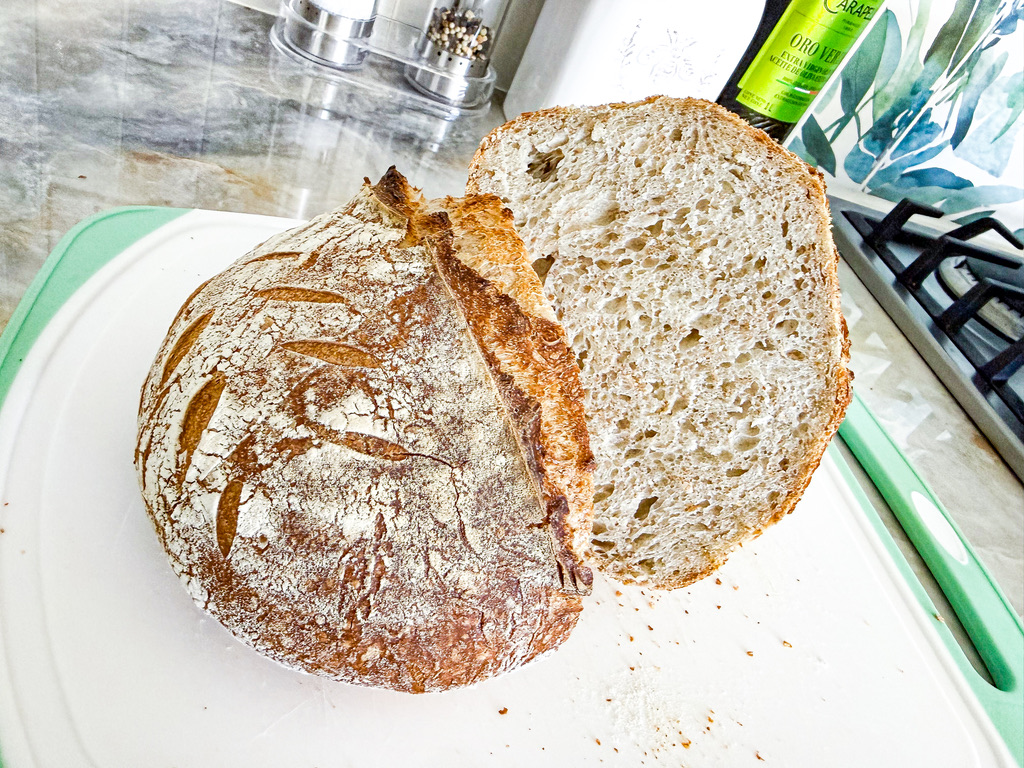
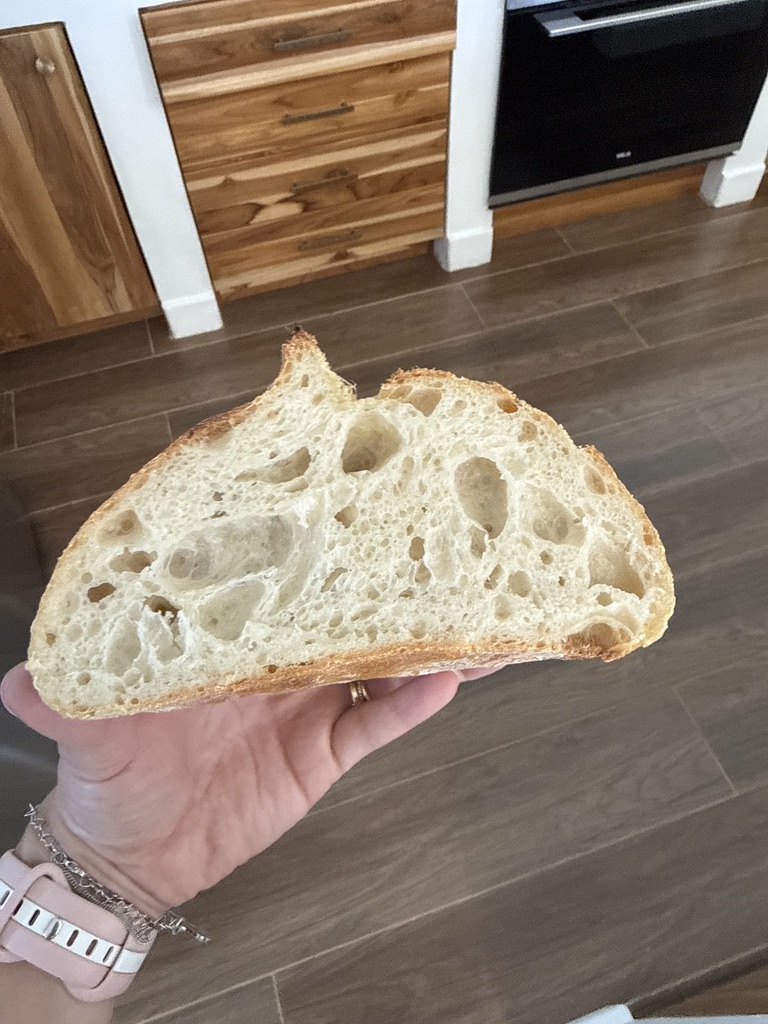
First, decide what “open” means to you
A good open crumb is light throughout, with a mixture of medium and larger air pockets connected by thin, well-baked walls. It should feel aerated rather than gummy, and the loaf should have enough structure to rise instead of spreading into a decorative bread puddle.
The most extreme version is not automatically the best bread. A wildly open crumb leaks olive oil, rejects jam, and can turn avocado toast into a shirt problem. Aim for the texture you enjoy eating, not the maximum possible amount of visible table.
Start with flour that can hold the bubbles
The dough needs enough gluten-forming potential to expand and retain gas. A dependable bread flour—or a strong all-purpose flour—usually gives a beginner the clearest path. A modest amount of whole wheat or rye adds flavor, but substantial whole grain makes a very open crumb more difficult because bran interferes with the continuous gluten network.
That does not make white flour morally advanced. It simply makes this particular aesthetic easier. If you are still learning your flour, begin with a mostly white blend and change one variable at a time. Read more about how flour changes sourdough.
Use enough water—not all the water
Higher hydration can make dough more extensible, allowing gas cells to expand. But water only helps if the flour can absorb it and the dough develops enough strength to contain it. A strong, well-fermented 72% dough may be more open than an 82% dough that collapses on contact with reality.
Choose a hydration you can still strengthen and shape confidently. Increase by 2 percentage points when you want to experiment. If the dough cannot hold itself after several folds, adding ambition by the tablespoon is unlikely to help. See the full guide to sourdough hydration.
Build strength early, then stop interfering
Mixing and folds organize the gluten network so it can retain fermentation gas. Early in bulk fermentation, several rounds of stretch and folds or coil folds can turn loose dough into something smooth, elastic, and gently domed.
Later in bulk, the priority changes from building the container to preserving what is inside it. Handle increasingly aerated dough with less force. You are not trying to save every bubble—shaping inevitably redistributes some gas—but relentless folding can erase the evidence of fermentation. Review stretch & fold and coil-fold techniques.
Fermentation is the main character
An open crumb cannot be shaped into under-fermented dough. During bulk fermentation, the dough should become visibly aerated, smoother, lighter, and more elastic, with bubbles along the sides and surface. The exact rise target depends on dough temperature and how much final proof remains, but many mostly white doughs are shaped after a roughly 40–60% increase in volume.
Under-fermented dough often produces a few giant tunnels near the top with dense, gummy areas below. Over-fermented dough may be full of gas but too weakened to hold it, leading to poor tension, spreading, and limited oven spring. Open crumb lives in the irritatingly narrow space where gas production and dough strength are both doing well.
Shape gently—but actually shape
“Do not degas” does not mean avoid touching the dough while whispering encouragement from across the counter. The loaf still needs a coherent shape and surface tension. Without enough tension, it expands outward instead of upward.
Flour the work surface lightly, use a bench scraper, and avoid pressing the dough flat. During pre-shaping and final shaping, preserve obvious air while creating a taut outer skin. If a single enormous bubble sits directly on the surface, pop it unless you are specifically hoping to bake one majestic cave.
Proof and bake for expansion
Final proof should leave enough fermentation in the dough for a light interior while preserving strength for oven spring. Cold dough is often easier to score cleanly, but refrigeration does not correct a poor bulk fermentation. Choose your proofing method with the cold-versus-counter guide.
Preheat the oven and Dutch oven thoroughly. Score decisively at an angle that gives the loaf room to expand. Steam—or the trapped steam inside a covered Dutch oven—keeps the crust flexible during early expansion. Then bake uncovered until the crust is deeply colored and the crumb walls have had enough heat to set.
Read the crumb instead of rating it
| What you see | What it may suggest |
|---|---|
| Large holes with dense, gummy areas | Often under-fermentation |
| Even but very tight crumb | Low fermentation, firm dough, heavy handling, or simply the formula |
| Open crumb in a flat loaf | Weak structure, over-fermentation, or insufficient shaping tension |
| Random tunnels directly under the crust | Trapped shaping bubbles or under-proofing |
| Light crumb with varied, connected holes | Balanced fermentation, strength, and handling |
Crumb clues overlap. Diagnose the slice alongside dough temperature, rise, handling, proofing, loaf height, and your notes from the bake. Sourdough symptoms enjoy refusing to identify a single suspect.
A practical open-crumb starting point
- Flour: Mostly strong white wheat flour, with 0–15% whole grain.
- Hydration: A manageable 72–76% for many flours—not an automatic leap into the 80s.
- Starter: Active, predictable, and used near its peak.
- Strength: Three or four early fold rounds, adjusted to the dough.
- Bulk: End when the dough is aerated and lively, not when a universal timer declares victory.
- Handling: Gentle enough to preserve gas, purposeful enough to create tension.
- Baking: Thorough preheat, confident score, steam, and enough color.
Further reading
Maurizio Leo’s resources discuss the relationship among flour, fermentation, hydration, and handling for open crumb. For the underlying science, see reviews of wheat dough structure and gas retention and how gas cells expand and set into bread crumb.